Journalists need to anticipate various kind of potential risks that they would encounter while covering events. The Managing Director of Lazarus Training Ltd, United Kingdom, Mr Alistair Hollington said media organisations should plan and outline the basic of risk assessment before deploying their personnel to cover any events in the field. Sharing his expertise at a webinar on Safety for Journalists, he pointed out that ‘journalists should report the news, don’t be the news’.
He gave real-life examples of road accidents by stressing the importance of risk planning and assessment such as communication plans, transport plans, emergency plans and evacuation plans. “All these should become the standard operating procedures (SOPs) as a culture of safety”, he added.
This is to ensure the resilience of media personnel from various perspectives including physical, mental, practical aspects, equipment, food, clothing and even first aids should also be looked into.
“Delay, but don’t abandon”
Another speaker, Mr Nadim Majeed from the Capital Maharaja Organisation Ltd, Sri Lanka spoke on safety precautions that investigative journalists and editors must take to ensure their safety while exposing corruption cases.
He said, “no story is worth your life, if there are serious safety risks or probability of violent reprisals, take a step back and re-evaluate the situation”. Mr Majeed suggested to delay the publication to re-assess the safety risks and come back to the story at a later date with the strategy ‘delay, but don’t abandon’.
“Some of the precautions that the editors can take would be assessing the risks early, plan early, monitor continuously, and handling threats responsibly,” he said, adding that one should be ‘MEAN’ when it comes to following safety guidelines.
Journalists – covered by OSHA 1994
The Resident Trainer of National Institute of Occupational Safety and Health (NIOSH) in Malaysia, Ms Ruzita Mohd Shariff, said journalists must identify the 5 types of hazards they will be facing while discharging their duties.
She categorised these hazards as Physical, Chemical, Biological, Ergonomical and Psychosocial. Physical such as slip, trip and fall from electrical cables or wires; Chemical like chemical spill; Biological such as the current COVID-19; Ergonomical like awkward posture during coverage or manual handling of heavy load and Psychosocial such as threat, bully and sexual harassment.
She said once the types of hazards are identified, journalists can then assess the risk of exposure and how to control, prevent and protect themselves under any circumstances. “Therefore, journalists must know how to balance between the requirement of work and the need to take care and protect themselves and their family members.”
Invest in the resilience of journalists through MHPSS & PFA
Senior Public Health Specialist of the Asian Disaster Preparedness Center (ADPC), based in Bangkok, Thailand, Dr Yvonette Serrano Duquo said Mental Health and Psychosocial Support (MHPSS) and Psychological First Aid (PFA) for journalists during emergencies, disasters and disease outbreaks is important.
“Most of the countries in this region do not have proper MHPSS guidelines for emotional and mental health care due to the lack of exposure,” she highlighted.
Dr Yvonette described journalists as ‘frontliners’. She said journalists need to gather ‘facts and figures’, thus it increases their vulnerability to infections and diseases while discharging their crucial role.
“Journalists need to have a “SELF HELP PLAN” and following some recommendations to booster their immune system is always essential at all times,” she advised. “It’s OK not to be OK. Don’t go beyond what you cannot do. Ask for help if you need to.”
Risk Communications: Media Interactions
The Head of Geo-Meteorological Risk Management Division (GMR), National Institute of Disaster Manager (NIDM) in India, Dr Surya Prakash, said there should be a chain of two-way communications involving the Citizens, Disaster Experts, Health Specialists, Officials, the Government, Media and Non-Governmental Organisations (NGOs).
Dr Surya suggested using digital communications or technological means to gather information rather than involving oneself physically. This, he said, will avoid getting infected or infecting others as asymptomatic carriers.
Journalists should be frank in discussing their mental health issue
The moderator of the session, Dr Ming-Kuok Lim, Advisor for Communication and Information for UNESCO Office Jakarta, said journalists should be frank in discussing their mental and physical health issues with their supervisors.
He said UNESCO and Reporters Without Borders have come up with a pocket-size guideline on safety for journalists, and urged all journalists, including freelance journalists to get themselves familiar with the guidelines.
He stressed that journalists, especially those going to dangerous parts of the world, must adhere to international norms and advices to protect themselves.
“The only constant thing in this world is ‘change’. If you remain unchanged, you might be lost and find yourself drowned in the sea of change,” he said.
In her concluding remarks, Director of AIBD, Ms Philomena Gnanapragasam, urged media organisations to play a crucial role in safeguarding the safety of their journalists.
More than 70 news reporters and journalists from across the Asia-Pacific region attend the 2 and half hours’ webinar, the 7th addition by AIBD since the Movement Control Order (MOC) was imposed on 18th March 2020.
]]>
Article by Qishin Tariq published in Star.my in reference to AIBD’s recent webinar on Cybersecurity.
As the conditional movement control order (CMCO) continues to keep families at home, away from the Covid-19 pandemic, another threat is on the rise: crimes targeting children.
“The global pandemic saw a surge in children joining the online world for the first time to support their studies and maintain social interaction,” said International Telecommunication Union (ITU) Asia Pacific senior advisor Sameer Sharma.
“The constraints also meant that many younger children began interacting online much earlier than their parents might have planned.”
Quoting Europol, he said there is an increase in postings in disreputable forums about how it’s easier to target children now, as they are more vulnerable due to isolation, are being supervised less, and exposed to online more, as well as an increase in those seeking child abuse material.

The Australian eSafety commissioner stated in March that one in four young people in Australia have been contacted by a stranger online, adding that while it could be harmless, it could also be inappropriate or unsafe.
In a report in April, eSafety said there is an increased risk of children being sexually abused during the Covid-19 pandemic, often when they are tricked or coerced into sharing intimate images or videos of themselves.
Its online investigations also found paedophiles discussing about how isolation measures have increased opportunities to contact children via platforms like YouTube, Instagram and various chat services.
Speaking during a web conference organised by the Asia-Pacific Institute for Broadcasting Development (AIBD), Prasar Bharati(India) and Malaysia Digital Economy Corporation (MDEC), Sameer said children are also generating more content of themselves, which could be used as child sexual abuse material.
Explaining the ITU’s Child Online Protection initiative, he said the tech sector has an important role to play in preventing violence online against children.
He urged for more proactive measures in developing age-verification systems; detecting, blocking and removing illegal and harmful material from online platforms; and for organisations to report and collaborate with law enforcement.
“Children and young people will no doubt face a different reality after the crisis and their future seems uncertain, therefore they will also have to be part of the solution,” Sameer said, suggesting that governments take in children’s views when developing policy on the pandemic.
Cybersecurity firm Welchman Keen managing director Phillip Victor warned that children are also contributing to online crimes against each other by cyberbullying and sending or requesting for explicit images.

Social media networks have to be moderated to prevent cyberbullying, says Victor, adding that some don’t do enough. — PHILLIP VICTOR
He said unlike predators who were usually strangers, cyberbullying often involved those in the child’s own social groups, with peers of a similar age.
Child rights advocate Shaney Cheng said unlike bullying, cyberbullying never stops.
“When children in school are bullied, it happens just in school. But if they’re on a social media platform or chat group, they can’t run away without leaving social media, which is not likely for most kids,” she said.
The problem is compounded as kids tend to not ask for help, and, worse, think it’s their fault, as bullies often blame their victims.
According to Cheng, bullying is usually not performed by an individual but a group, and this is exacerbated by the social nature of online platforms and chat groups which make it easier to gang up on a kid.
“Online is an escape for children, away from stress of family life, which can be worse during this period at home,” she said.
Platforms have to be moderated to prevent bullying, said Victor, citing TikTok as an example, as it often courted controversy, because it employed less moderation compared to Facebook.
“Kids like being important, so they chase followers and likes, they care about the numbers but don’t worry about who is following them. This prompts them to not keep their account private, which can expose their personal information,” he said.
Predators tend to stalk platforms which are widely used by youths, said Cheng, adding that they try to blend into the victim’s community.
They are also likely to pretend to be young, and use a child’s personal info such as the games he or she plays to make it easier to get to know the child.
“This could be a prelude of what’s coming. Predators are grooming kids now, even if they can’t meet. They start conditioning the kids online, and capitalise on it after the lockdown period,” said Victor.
Easy targets
Cheng said the at-risk age group is getting younger, now starting with kids from seven to 10 years old according to child rights non-governmental organisation (NGO) Operation Underground Railroad.
This is because parents are letting their kids use smart devices even before preschool, including allowing children on social media, and even making accounts for them.
“Some children have their own phones, while others share their parents’ phones. Even then they can still get in trouble. It’s not about who sets up the account, but the education needs to be on what to do when there is danger and what to do next,” she said.
Parents have to treat their children with more respect so their kids would be willing to turn to them for help and support, says Cheng. — SHANEY CHENG
Children tend to be curious and are taught to be polite, Cheng said, which makes them easy to target, as some don’t know how to say no.
According to Victor, children are also more open to talking to strangers due to having more free time during the pandemic.
“They don’t have face-to-face interaction with their friends, but they feel the need to communicate with somebody, be close to somebody. This can expose them to predators who act friendly,” he said.
It all comes down to the sheer amount of time spent online. While they could be chatting with friends for several hours a day as usual, they still have a whole day away from school to be on the Internet.
“They can only chat with friends for so long before looking for other things to do. An idle mind is the devil’s workshop,” he said.
No shortcuts
Like their children, many parents are also homebound due to CMCO, especially those with the option to work from home.
Though parents are home, they would likely be too busy with meetings and work duties.
“Kids are under the same roof, but also alone. They see them on the computer and occupied, but what the kids are actually doing is the concern,” said Victor.
He suggested having the child use a computer or smart device in an open space rather than allowed to be holed up in their rooms. He also recommended parents to keep channels open for communication rather than just policing the kids.
“Parents must tell their kids there is help, and that they are there for them. Be observant if your child’s behaviour is changing and look out for depression or anxiety,” he said.
Even though he works in the cybersecurity field, Victor said he does not monitor his children, because if he did and they found out, they would shut him out in the future.
“It’s like how people are nervous around cops even if they aren’t in the wrong,” he explained.
Cheng agreed that it was important to treat children with respect to show there’s no difference in power dynamics.
“Parents tend to instruct children even though kids are more tech savvy than them. Instead they should create a safe space where kids can talk about things they’re uncomfortable about,” she suggested.
She revealed that a predator typically tends to tell children that their parents would confiscate their phone if they are made aware of the existence of the predator.
“Adults usually take the shortcut, they just take away the phone or Internet access. But they have to accept that a child’s life is connected to the Internet, as now even preschoolers are taking classes online,” she said.
Asked what parents could do to taper children’s time online, Cheng said it comes down to creating alternatives to fill their time.
“It’s quite sad really, I’ve talked to kids about time spent on screen and they asked what else they can do,” she recalled.
She suggested rather than telling kids to just put away their phones, it is more effective to create activities for them to do offline, like doing chores or hobbies and reading in exchange for screen time.
She reminded parents that just being physically present at home wasn’t enough, as they still needed to set aside time to pay attention to their kids.
“Look around at a restaurant and the whole family is on their screen, sometimes they are even texting each other. Parents have come to realise the screen is the fastest way to keep them quiet,” she said.
Parents should take advantage of what time they have at home to open lines of communication with their children, even if that meant letting them stay online on their phones.
“It’s not about putting aside the gadgets, but about communication,” she summed up.
Amidst COVID-19 pandemic the role of Public Service Broadcasters (PSBs) has once again come to the limelight. It has not only become the source of credible information but also of education and entertainment. With lockdown in place in many countries, and avalanche of misinformation, the PSBs have become the ’go-to-source’ for accurate information and voice of ‘reassurances’ in a difficult time.
It is the ‘Rebirth’ of PSBs, exclaimed the Chief Executive Officer of India’ Public Service Broadcaster, Prasar Bharati, Mr. Shashi Shekhar Vempati. The unintended affect of all this, he said, is that PSBs have become the most viewed channels and most ‘responsible’ in India. “Doordarshan is in the top of the charts in viewership,” he claimed.
“There have always been a challenge to bring back families to watch television together, which was the case in the past,” he said, adding that now, with this crisis, families are coming together, bonding together.
But, for how long, questions Dr. Kim Youngyiil, Project Manager of EBU and AIBD. After this pandemic, ‘there will be economic downturn, advertising revenue for television will go down, and as it is there is numerous challenges from private media and tech giants’, he said. “What shall we do after this- to keep our prestige,” he lamented.
Dr. Amal Punchihewa, a media consultant (engineer) and an adjunct professor based in New Zealand said the value of Public Service Media has gone up during this crisis and more efforts must be put in to remain relevant to the public. In recent years, many PSMs are focusing on education, which according to him is a good step forward. He said there should be ‘interclusion’ of services to sustain and remain relevant for many more years to come.
If there is one thing that is spreading faster than the corona virus, then it will be misinformation, rumours and fake news. This was the general consensus among the panelists and experts during the virtual COVID Response Session. “There is a parallel epidemic- grappling with sheer volume of misinformation,” remarked Mr. Shashi Shekhar Vempati, Chief Executive Officer of Prasar Bharati, India’s Public Service Broadcaster.
The Chief Finance Officer of Prasar Bharati and President of AIBD General Conference, Mr. Rajeev Singh, said the role of media has become even more crucial. “Besides its traditional functions of informing and educating, it now have to dispel all wrong notions, apprehensions and misinformation”.
Dr. Ming-Kuok Lim, Advisor for Communication and Information, UNESCO Office in Jakarta said whenever there is a new situation or unknown situation, there will be misinformation. He said there is more of misinformation, where people share unwittingly with others, than disinformation. Disinformation is when people deliberately manufacture wrong information and share for various reasons.
He urged journalists to ensure that the information they are producing should be factually correct. He suggested that media outlets should have fact-checking facility built into their system. “It is a process you have to start building it because when a pandemic like this strikes, at such speed, there is no time”.
There is avalanche of rumours and fake news creating ‘COVID Infodemic’ in the society, said Dr. Liviu Vedrasco, WHO COVID-10 Asia-Pacific Liaison based in Thailand. He said the media should help dispel this and reach out quickly so that it doesn’t distract from the response.
What are media outlets doing?
At Korea Broadcasting System (KBS), Dr. Kim Youngyiil, Project Manager of EBU and AIBD, said one of the reasons for instituting ‘COVID-19 Integrated Newsroom’ was to fight wrong information and rumours circulating in the society. “It is geared towards delivering actual information in a speedy manner,” he said.
The Director General of Doordarshan News, Mr. Mayank Agarwal, said they have formed a WhatsApp Group involving DD News, All India Radio, and Prasar Bharati News Service, to bust misinformation and rumours. All the doubtful materials are screened and fact-checked, he said.
The Asia-Pacific Institute for Broadcasting Development is conducting a year-long research called ‘Angkor Anti-Fake News’ project. More than 60 questionnaires were collected from member organisations representing almost 20 countries. The outcome will be launched during its General Conference scheduled to be held in August in Laos. Based on the findings and recommendations various trainings and workshops will be planned to train journalists and news organisations.
Ms Philomena Gnanapragasam, the Director of AIBD payed a courtesy call on the Honourable Secretary, Ministry of Information and Broadcasting (MIB), Shri Ravi Mital, IAS on the 15 January 2020, at the MIB Office in Shastri Bahwan New Delhi. Shri Ravi shared his insight on the changing trends of media and the Digital Age, and the further efforts by the Government of India on working closely with the international media organisation for the betterment of the Asia Pacific region.

Ms Gnanapragasam said that AIBD, as an international intergovernmental organisation, has a mandate to advise and educate its member governments and organisations on issues and trends shaping the media industry. The director added that AIBD looks forward to a more vibrant collaboration in the area of knowledge sharing in the region.
Elaborating on the AIBD ‘Anti Fake News Initiative’ the Director stated that it is important to empower the people with media literacy awareness and advocacy.
The insightful discussion ended with the Honourable Secretary agreeing to the plan of organising seminar or short conference on Fake News and Data Regulation outside Delhi. Mr Vikram Sahay, the Joint Secretary of MIB, was also present at the meeting.
Visit to Prasar Bharati House in Copernicus Marg, New Delhi
Next Ms Philomena Gnanapragasam, the Director of AIBD called upon Shri Shashi Vempati, Chief Executive Officer, Prasar Bharati. During the meeting the Director highlighted AIBD’s key activities and initiatives. Shri Vempati, discussed the many challenging factors on how to drive and monetise an organisation with an aging workforce.
The focal person for Prasar Bharati, Mr Sunil, Addl. Director General (Engineering) who is also the Directorate General Doordarshan and Mr Raman Kumar, Director in-charge of all the international relations for Prasar Bharati including Doordarshan and All Radio India, were also present for this meeting.

Visiting Doordarshan (DDI) and All India Radio (AIR)
A request to engage Indian experts for training from Doordarshan and having additional technical workshops to enhance capacity building was discussed during the meeting at Doordarshan. The Director reiterated that AIBD is happy to partner with DDI to organise such future collaborations in the region.
Meanwhile at the meeting in All India Radio, Dr Sangeeta Goel, Addl. Director General, suggested Workshop on Gender Sensitisation and Seminar on Media Literacy for future collaborations.
Visits to Broadcast Engineering Consultant (BECIL) and Consortium of Education (CEC)
The next day was reserved for the affiliate members of AIBD, with the first visit to Mr George Kuruvilla, the Chairman & Managing Director of Broadcast Engineering Consultants India Limited (BECIL), whereby both two sides discussed about possible partnerships in 2020 and beyond. The BECIL agreed to support AIBD in providing trainers/experts and consultancy for AIBD member countries in the field of broadcasting, telecommunications for the media and technology development in the region.
This was followed by a meeting in the IUAC Campus of the Consortium for Educational Communication(CEC), where Ms Gnanapragasam met Prof. Jagat Bhushan Nadda, Director CEC.
He was joined by his renowned team-Mr Nageshwar Nath, Joint Director (HW), Dr Sunil Mehru, Joint Director, Mr Navin Soi, Chief Administrative Officer and Mr K.S. Mahejan, Consultant. Prof Jagat shared the information on the establishment of CEC as one of the Inter-University Centres set up by the University Grants Commission (UGC) of India in 1993, focussing on Digitalised Higher Education with Content Across Diverse Disciplinary Stream. Ms Gnanapragasam spoke of how honoured AIBD is to be part of CEC`s vison to illuminate the path of digitalisation of higher education, to address the issues of equity, access and quality in higher education, through broadcast and non-broadcast media in India. She added that AIBD prepared to collaborate with CEC in any training activities and initiative for digital media and technology development in the region. 
AIBD/NABM Sub-Regional Workshop on Studio & Newsroom Automation in Kingsway Camp, 13-17 January 2020
AIBD in collaboration with Prasar Bharati and NABM conducted a Sub–Regional Workshop on Studio & Newsroom Automation in Delhi from 13 to 17 January 2020.

AIBD Director, Ms Philomena Gnanapragasam, and the Compliance & Strategy Operation Officer, AIBD, Ms Lee Lai Mee were present at the certificate awarding ceremony. The Director took the opportunity to thank the CEO for the successful organisation and conclusion of the workshop. Six foreign participants of the workshop had the honour of receiving their certificates personally from the CEO in his office.
After the training concluded, AIBD team met with the Addl. Director General NABM, Gp Captain Ashok Nigam and discussed on possible collaborations in future training activities
]]>

ADRENALIN RUSH & A WHOA! ADVENTURE- Novice Rafting & Drum Circle Team Bonding
As work stress mounted and routine by day became energy sapping, the staff of AIBD took off to a great one-day team building trip in Kg Ulu Slim, Slim River on 11th October 2019. It aimed to give the staff a way to relax out of Kuala Lumpur and be with team mates to destress, energize and promote a deeper sense of camaraderie.
The team building programme also aimed to inculcate the work values & ethics such as team work, motivation, conflict resolution, risk taking, creativity,boost morale and leadership.
Cheered on by the saying ‘Never be afraid to try something new. Remember amateurs built the Ark, professional built the Titanic`, the majority of the staff voted to go on a white water rafting experience, to let the adrenalin rush and be WHOA by it!
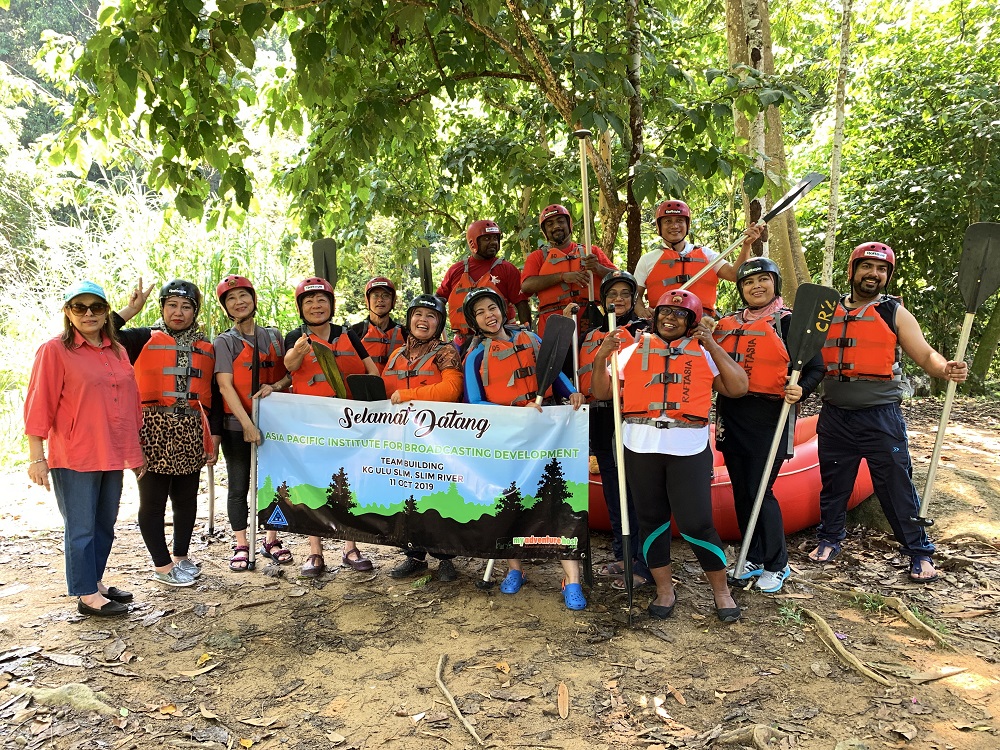
Kg Ulu Slim is just 140kms, about 1 1/2hours from Kuala Lumpur and the 7kms Slim River Rapids Grade3 (intermediate level river) was great fun, the adrenalin rush cannot be explained by words for novice rafters like us.
My Adventure Host team, led by Mr Izz Idris (Izni) assisted us with the logistics. He provided impeccable service throughout the day, along with the incredible warm-welcoming nature of his co-hosts that orchestrated the rafting activities. Our wonderful moments were even captured by his team offsider.
From the basecamp at Kg Ulu Slim, we had awesome 4WD experience to the Put- In Point at Kuala Tibang, about 4 kms from the basecamp. We had a chance to see some Orang Asli (indigenous people) villages along the way. At Kuala Tibang, besides getting our rafting equipment -helmet, paddles and PFD(Professional Floatation Device), a detailed briefing on safety and procedures of white water rafting was given by Ms Eja, the raft instructor and her team of river guides. We were then divided into 4 groups with 2 guides in each raft. Snacks and drinks were provided at pit-stop.
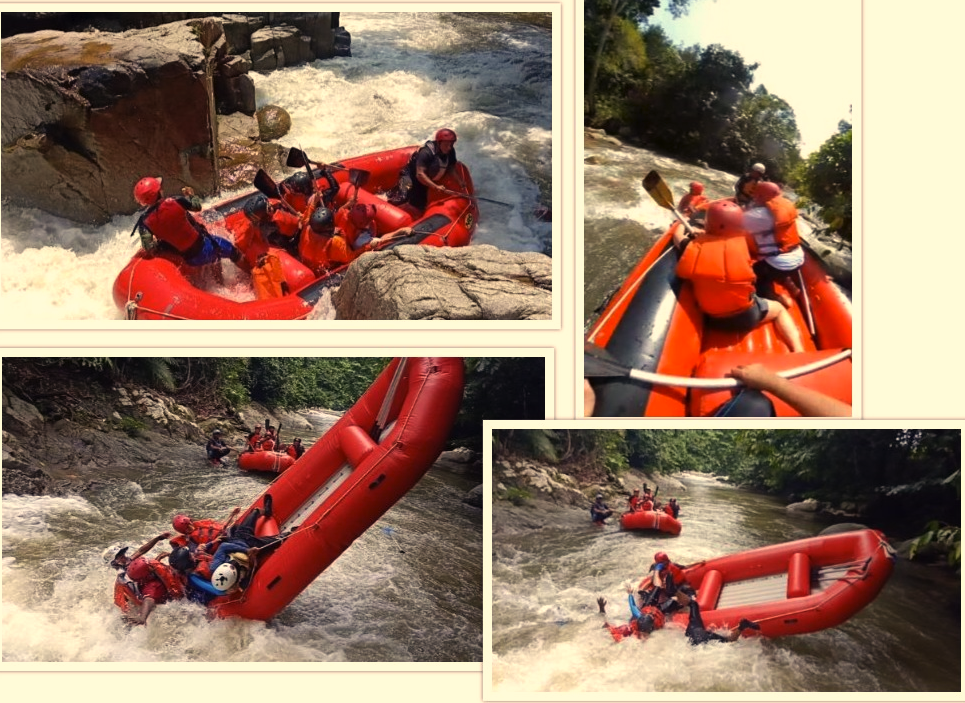
Cool! The river was as so-called`slim` that we had to squeeze through many rocks. Often, we had to jump from left to right-right to left in the raft and falling on top of each other. To reach the Take-out point at Post Bersih, Rule no. 1 learned- teamwork; Rule no.2-trust & obey/follow the instructions of the leader (river guide)- ALL RIGHT, ALL LEFT, ALL FRONT, ALL BACK, ALL IN and NORMAL. Rule No.3: team spirit and calm response when risk arise- when the raft overturned, somebody fell off the raft or succumbed to an over flipped and have to swim the last rapid before the take-out.

Drumcircle Team Bonding Activity
In this activity, drumming was used as the vehicle for creating connections among us and ultimately in the workplace. It uses rhythm to explore and inspire group empowerment, leadership and build better relationship. According to the drumming instructor, Mr Haiqal, drumming builds effective teams and inspires oneness towards a common goal.
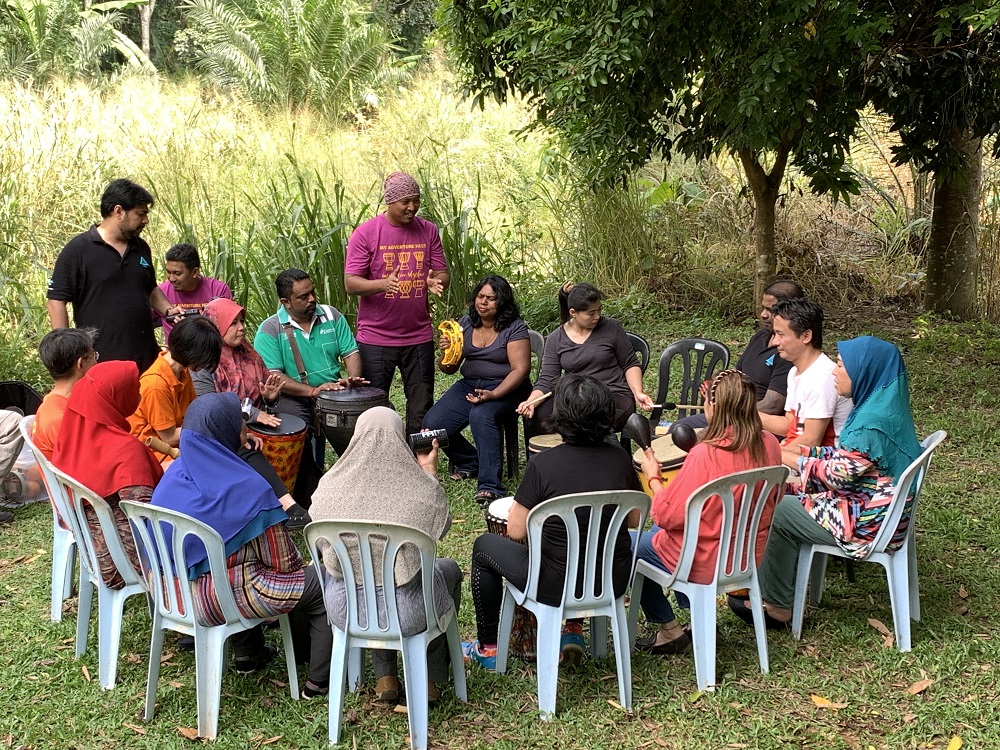
We had a fun time trying to create simple rhythms by playing percussion instruments in a drum circle. We were required to concentrate, listen and communicate through rhythms. Creating spontaneous rhythms and beats helps to reduce stress and releases negative energy besides promoting creativity.
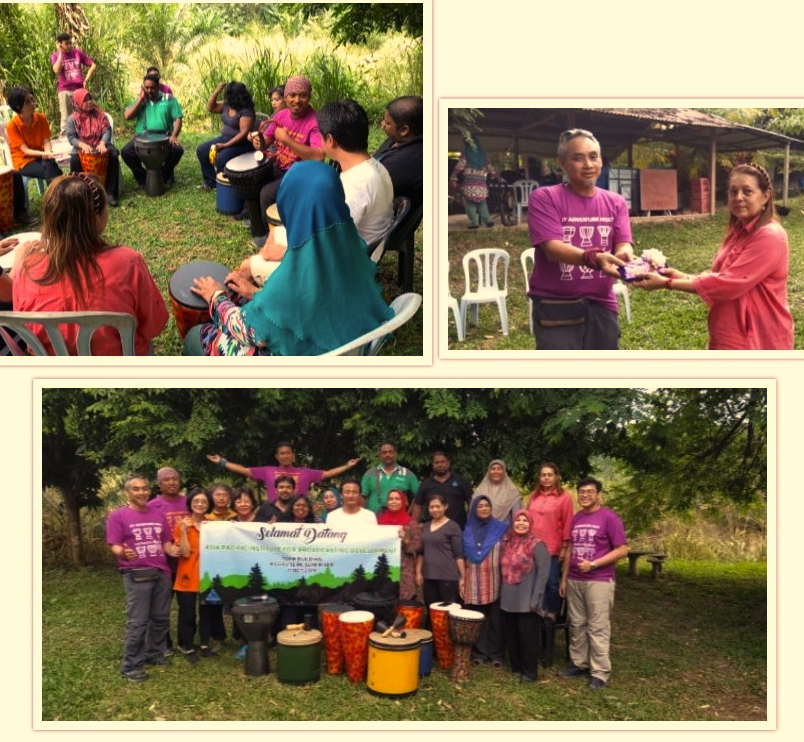
We were amazed at how fast we can create simple rhythm and beat together as a team when we had to showcase our learnings in AIBD GOT TALENT presentation. Lalalala,lalalaah,lalalalah,lalalaah… was such an effective method to motivate team spirit working together besides increasing potential skills that we have.
All in all, in just a day, we really learned that when the going/crisis gets tough, there is no turning back but just follow the leader, stay focus towards oneness in achieving the common rhythm /goal and drop the past if the loads get heavier, just move on. For this moment, we have just supported the local communities to make a living from eco-based tourism.
]]>
Radiodays Asia 2019 is poised to foster a new dimension for the professional media development and businesses in radio and audio industry in Asia.
AIBD’s Director, Mr Chang Jin says with the advent of digital technological evolution, all media including radio and audio industry are embracing the demand of challenges from changing media consumption and the rapid transformation of the media businesses.
The upcoming event, Radiodays Asia 2019, will serve as a unique platform for the Asian radio and audio businesses, with a special focus on Asia’s vibrant, diverse and progressive market trends.
He made this remarks at the Press Conference marking the launch of the inaugural Radiodays Asia 2019 which will be held in Kuala Lumpur on 27-28 August at Hotel Istana in the city capital.

AIBD and Commercial Radio Malaysia (CRM) are the Premium Supporting Partners for Radiodays Asia 2019.
Below is the detailed information on Radiodays Asia 2019.
- A NEW RADIO CONFERENCE FOR ASIA: Announcing the launch of Radiodays Asia in 2019!
- Host City Kuala Lumpur, Malaysia 27-28 August 2019
- In partnership with the Radiodays Europe and Asian broadcasting organizations (AIBD and CRM)
Kuala Lumpur, Malaysia: A NEW international radio and audio conference is coming to South East Asia in 2019.
Launched on 6th December at a press conference in Kuala Lumpur, Radiodays Asia will take place in Malaysia, 27-28 August next year.
Radiodays Asia is the NEW conference from the team who produces Radiodays Europe, the world’s largest and leading conference for radio and audio development, now in its 10th year. The press conference is being streamed live on Twitter from 10.30 AM local time Malaysia – https://twitter.com/AsiaRadioToday
Anders Held Founder of Radiodays Asia and Project Manager said today:
“Since 2013 Radiodays Europe has been invited to bring radio expertise to the Asia Media Summit and we have seen a number of visitors from Asia at the Radiodays Europe events. This co-operation has grown and we are happy to announce today the launch of Radiodays Asia, 27-28 August 2019, Kuala Lumpur, Malaysia. I think Europeans and Asians have a lot to learn from each other in a time when challenges are more and more global. We, Radiodays Europe, and our partners in Asia-Pacific will make sure this is a conference focused and relevant for Asian markets, but bring the best and most important high level speakers from across the world to Radiodays Asia. It will be a once a year highlight and inspiration for Asian broadcasters.”
Why Radiodays Asia?
Radiodays Asia will focus on the future of radio and audio businesses in Asia. This new conference will bring top-level speakers from around the world to share their ideas, thoughts, strategies and plans for the future of radio and audio.
All media platforms, including radio, are facing growing challenges from changing media consumption and the fast transformation of the media business. At the same time, there is a worldwide rise in investment and usage of audio on new platforms, opening up a new dawn for radio and a new golden age of audio.
Over the last decade, Radiodays Europe has become a platform for European broadcasters to discuss and learn about future challenges for radio and audio. Radiodays Asia will deliver the same platform to Asia for the Asian radio and audio businesses, with a focus on Asia’s vibrant, diverse and progressive radio markets at the inaugural Radiodays Asia 2019. It will be full of new ideas and progressive business trends!
This NEW radio and audio conference is being held in collaboration with Asia-Pacific partners including: Premium Supporting Partners Asia-Pacific Institute for Broadcasting Development (AIBD), Commercial Radio Malaysia (CRM) and Partner Organisations: Asia Radio Today, Commercial Radio Australia, Minister of Tourism Arts & Culture Malaysia, Malaysia Conference and Exhibition Bureau (MyCEB) & Malaysia Truly Asia and Podnews.net
“AIBD is pleased to be a Premium Supporting Partner for Radiodays Asia, to be launched in 2019. I believe this will be a new and distinct platform for Radiodays Europe to embrace the Asia-Pacific region, and for the latter to learn about the advanced new trends in the radio and audio industry, as an enhancement of the successful cooperation between AIBD and Radiodays Europe in the framework of the Asia Media Summit since they joined hands in 2013. While the media landscape is being transformed in many ways, there are more challenges and opportunities for the sound media. AIBD hopes all its members can benefit from this high-calibre industry event and bring the radio and audio in Asia-Pacific to ever new heights”. Chang Jin, Director, AIBD
“CRM is delighted to be a Premium Supporting Partner for Radiodays Asia, to be held in August 2019. A special thanks to Radiodays Europe for giving CRM the opportunity to co-host the first Radiodays Asia in Kuala Lumpur, Malaysia. I believe with such a diverse group of participants from Asia-Pacific region, this conference will be an important platform for us to engage and share experiences on emerging trends and challenges facing the radio and audio industry. We at CRM realise that consumers’ media consumption habits are always changing and for that, we continue to embrace and evolve with these changes and coming up with new and exciting revolution in radio. It is our hope that Radiodays Asia will be an inspiring and thought provoking conference in 2019 where Asian broadcasters would benefit the most.” Ozarizan Mohd Nor, President, CRM
The best speakers from Asia & the rest of the world!
Speakers for Radiodays Asia will include the most knowledgeable and sought after international experts from the radio and audio industries, plus those from other fields such as digital trends, new business models and journalism. When choosing speakers we look for innovative and inspirational speakers on their chosen subject related. If you have suggestions for speaker or sessions for Radiodays Asia 2019 please send these to Anders Held, Project Manager, Radiodays Asia: anders@radiodaysasia.com
Speaking at today’s launch, Asia Radio Today publisher Steve Ahern said, “The first time I went to Radiodays Europe I was astonished at the energy and optimism of the event. It is a conference that helped European radio turn a corner and build new confidence in the future of the radio and audio industries. Asian radio businesses can expect to be inspired by new ideas and energy when Radiodays comes to Asia.”
Kuala Lumpur the Host City
The national capital of Malaysia, Kuala Lumpur is also its largest city. Having undergone rapid development, it has become a popular destination thanks to its fascinating history and growing cultural scene. There’s plenty for visitors to enjoy, from historical buildings to natural attractions, great shopping, food and bustling nightlife, all at a very cost effective price. Accommodation in KL ranges from top international hotels to competitively priced budget accommodation.
The Format – 2 days dedicated to radio in Asia!
Radiodays Asia will run over two days and will contain two parallel tracks to enable a wide spread of topics and more specialized sessions. Some sessions will be fast paced, with shorter presentations; others will be panels, keynotes and inspiring case studies.
Join the Exhibition to promote your business or service in Asia
Radiodays Asia will offer commercial companies and service providers business opportunities. Different commercial packages will be offered and a professional exhibition organized. For further information on sponsorship or exhibition opportunities please contact: frederik@radiodaysasia.com
Radiodays Asia Testimonial Quotes from our Partners:
Media Partners & Partner Organisations:
Commercial Radio Australia
Commercial Radio Australia (CRA) is the national industry body for commercial radio in Australia with 260 AM, FM and DAB+ station members nationwide representing 99% of the commercial radio licensees on air.
“Commercial Radio Australia is pleased to support the launch of Radiodays Asia. As radio continues to reinvent itself, creating new partnerships and looking outwards for collaboration across a range of industries will help us continue to prosper and grow. Radiodays Asia will provide a new forum for ideas and networking across the region and the rest of the world.” Joan Warner, CEO, Commercial Radio Australia
Podnews.net
Your free daily briefing email – Join 4,834 subscribers worldwide: get a daily briefing in your inbox every weekday about podcasting and on-demand. Concise, to the point, and a truly global view!
“I’ve been to every Radiodays Europe since it started; and they are a real highlight of the year: a collaborative, positive spirit that helps all in radio and audio. I believe that it’s no coincidence that European radio is posting record revenue and audiences. Now I’ve moved from Europe to Australia, I’m delighted that Radiodays Asia will be radio’s meeting place in this part of the world.” said James Cridland, Editor of the podcast newsletter Podnews.
Launch Partners:
Triton Digital
“Triton Digital is pleased to be a launch partner for Radiodays Asia,” said Benjamin Masse, Managing Director, Market Development and Strategy at Triton Digital. “We are eager to help accelerate the growth of the online audio industry in this diverse and fast-growing region, and are confident that this conference will be the perfect forum to gather both radio and audio professionals to share experiences, success stories, research, trends, and more. We look forward to the excitement and momentum that this conference will undoubtedly ignite around the present and future of the audio industry in Asia.”
RCS
RCS Vice President Asia Pacific, Keith Williams shares his excitement, “RCS has been a sponsor of Radiodays Europe from the beginning. Expanding the event platform on the global stage fits perfectly with our business model and we are pleased Kuala Lumpur is the selected host city. RCS is the World’s Largest Broadcast Software company and we look forward to sharing our expertise with the media landscape represented at Radiodays Asia.”
Wedel Software
“After being a partner with Radiodays Europe almost since the beginning, we are excited to be a part of this new chapter in Radio. Kuala Lumpur is a great choice for a location since it is the home of one of our largest customer.” says Raoul Wedel, CEO, Wedel Software
Premium Supporting Partners, Supporting Partners & Launch Partners
This NEW radio conference is being held in collaboration with partners in the Asia-Pacific. Radiodays Asia is pleased to announce as Premium Supporting Partners the following organizations, radio associations and companies:
- Asia-Pacific Institute for Broadcasting Development (AIBD)
- Commercial Radio Malaysia (CRM)
- Radiodays Europe (RDE)
]]>
Radio has given me great pleasure over the years – not only as a listener, but as a presenter, producer, programme manager and general manager. In my 30 years of broadcasting, I have watched the humble radio develop into a sophisticated device capable of delivering information to a variety of media platforms. Digital radio has opened-up new opportunities for stations to become more creative and specialised using text, sound and vision.
Today, radio still plays a vital role in entertaining, informing and engaging listeners and is no longer a one-way communication tool. Social media has allowed listeners to interact with presenters and other listeners instantaneously, strengthening its primary goal of reaching people.
28 participants from Malaysia’s RTM networks recently attended an In-Country AIBD/IPPTAR workshop in Kuala Lumpur, focussing on today’s radio. This 4-day workshop, designed for producers and presenters, was aimed at enhancing the skills of creativity in radio’s content formations. Entitled ‘Creating Content for Today’s Radio’, it was held at AIBD premises in Kuala Lumpur from July 23 to July 2018.
Topics of the workshop covered included:
- Understanding the craft – Station identity and branding;
- Tips for producing radio;
- The arts of interviewing;
- Interactive communication between presenters and co-presenters;
- Tools for building a successful talkback/interactive programme; and
- Creating field reports and packages.
The workshop also held a special joint presentation with Dr Les Sabel from S-Comm Technologies on digital radio broadcasting services. This session addressed the latest on DAB+ technology and the issues and challenges facing engineers and content makers, with the goal of delivering more creative programme initiatives in the future.

Radio stations have been quick off the mark to integrate social media into their day-to-day programming and promotions. The latest data continues to show increases in online audio listening, social media usage (especially Instagram and Snapchat) and Facebook Live. This workshop explored imaginative ways to give radio stations the creative edge to attract listeners using Twitter, Facebook (including Facebook Live) and other social media platforms.

Participants also shared their own experiences and knowledge working in radio as well as the opportunity to create new programme ideas based on target audience, multi-media platforms and social media. Each group gave a lively presentation on their findings designed to build and attract new and existing audiences.
Day four addressed the day-to-day programming tool of hot clocks to assist radio stations with creative scheduling. Participants were given the opportunity to design new templates for their shows based on the successful ‘hot clock formula’ and to design a new station sound for the digital broadcast era.
The final day gave participants an insight into where radio is heading and how best to prepare. From the growth of mobiles to the renaissance of local radio, the broadcast industry continues to dispose of old technology in favour for going entirely digital. With seventy-five (75%) percent of cars expected to connect to digital services by 2020, a revolution in radio content is upon us led by advertiser and consumer demand. And with the merging of radio, TV and online news under single operators, as well as voice activated devices and metadata, comes new opportunities for those who still love radio.
]]>Radio has given me great pleasure over the years – not only as a listener, but as a presenter, producer, programme manager and general manager. In my 30 years of broadcasting, I have watched the humble radio develop into a sophisticated device capable of delivering information to a variety of media platforms. Digital radio has opened-up new opportunities for stations to become more creative and specialised using text, sound and vision.
Today, radio still plays a vital role in entertaining, informing and engaging listeners and is no longer a one-way communication tool. Social media has allowed listeners to interact with presenters and other listeners instantaneously, strengthening its primary goal of reaching people.
28 participants from Malaysia’s RTM networks recently attended an In-Country AIBD/IPPTAR workshop in Kuala Lumpur, focussing on today’s radio. This 4-day workshop, designed for producers and presenters, was aimed at enhancing the skills of creativity in radio’s content formations. Entitled ‘Creating Content for Today’s Radio’, it was held at AIBD premises in Kuala Lumpur from July 23 to July 2018.
Topics of the workshop covered included:
- Understanding the craft – Station identity and branding;
- Tips for producing radio;
- The arts of interviewing;
- Interactive communication between presenters and co-presenters;
- Tools for building a successful talkback/interactive programme; and
- Creating field reports and packages.
The workshop also held a special joint presentation with Dr Les Sabel from S-Comm Technologies on digital radio broadcasting services. This session addressed the latest on DAB+ technology and the issues and challenges facing engineers and content makers, with the goal of delivering more creative programme initiatives in the future.
Radio stations have been quick off the mark to integrate social media into their day-to-day programming and promotions. The latest data continues to show increases in online audio listening, social media usage (especially Instagram and Snapchat) and Facebook Live. This workshop explored imaginative ways to give radio stations the creative edge to attract listeners using Twitter, Facebook (including Facebook Live) and other social media platforms.
Participants also shared their own experiences and knowledge working in radio as well as the opportunity to create new programme ideas based on target audience, multi-media platforms and social media. Each group gave a lively presentation on their findings designed to build and attract new and existing audiences.
Day four addressed the day-to-day programming tool of hot clocks to assist radio stations with creative scheduling. Participants were given the opportunity to design new templates for their shows based on the successful ‘hot clock formula’ and to design a new station sound for the digital broadcast era.
The final day gave participants an insight into where radio is heading and how best to prepare. From the growth of mobiles to the renaissance of local radio, the broadcast industry continues to dispose of old technology in favour for going entirely digital. With seventy-five (75%) percent of cars expected to connect to digital services by 2020, a revolution in radio content is upon us led by advertiser and consumer demand. And with the merging of radio, TV and online news under single operators, as well as voice activated devices and metadata, comes new opportunities for those who still love radio.
]]>Mr Baek Sang-Hoon, Director at the Drama Production Department of the Korean Broadcasting System (KBS) which produces Korean dramas highly popular in Asia, identifies several success factors for impactful storytelling.
“ Storytellers must understand audiences and be empathic with their needs and desires”, he said.
The Korean Director also said the story or programme must be exciting, offering something different. It must also have different product system, subject and backdrops. “That’s the formula that made Descendants of the Sun succeed”, Sang-Hoon told delegates who attended the Plenary Session on Mythology, Folklore and Contemporary Stories at the Asia Media Summit held in New Delhi, India on 10 May 2018.

Sang-Hoon directed the episode “Doctors without Borders”, one of 16 episodes of Descendants of the Sun which won the top prize for Best Story in a competition organised by the Korean Chamber of Commerce & Industry (KCCI).
Descendants of the Sun,which chronicles the star-crossed relationship between a soldier and a surgeon, was immensely popular both locally as well as internationally. It has been sold to 32 countries and translated into 32 different languages. According to the report by the Export-Import Bank of Korea, the direct and indirect economic effects of the KBS 2TV military-romance TV series “Descendants of the Sun” are estimated to hover above 1 trillion won ($880 million).
In his presentation, Director Back said the film offers action scenes, gun shooting, car chase, disaster, and what happens after these situations, including importantly a love story.
“The audience wanted to see a love story in the disaster not the disaster itself. Audiences change with times. Smart story tellers can put their fingers on the pulse of the time. That’s how they could develop stories that appeal not just to Korean audience,, but also to Asian audience.”, he said.
The Korean Director also said that exciting stories should come from understanding viewers, being on the same page with them, and being empathetic with their needs and desires.
What’s in it for the audience?
Another speaker was Mr Jason Bernard Santos, a Philippine writer, producer and director, who presented the “Wirewalkers”, an award winning documentary which employs virtual reality as part of the story.
“We tell the story to students, teachers, parents and government officials using 360 degree footage of the river where kids from Iligan City in southern Philippines cross the steel cable to go to school”, he said.
In two months time, he said, “the national government responded by building a suspension bridge in the village. Kids no longer have to cross the dangerous bridge going to school”.
Wirewalkers…
He shared his formula for good storytelling, saying he follows four steps in changing and challenging the narrative of the stories we do:
What is the story?
What is the issue, or the content that this story is going to be dealing with?
Whose story is it?
Who is the character, or characters, that will lead and guide your story? What’s driving them emotionally?
What’s the big question?
What is it in your story that is going to leave the audience in anticipation, what is it that they will want to find out and see resolved?
And probably the most important one:
What’s in it for the audience?
What are the big universal themes that connect us all as humans? Think about the things we can all relate to, and that allow the audience to put themselves in the characters’ shoes.
Other plenary session speakers were Carol Ying Yu of Phoenix Satellite Television, HongKong, China, K.G. Suresh, Director General of IIMC, India, Malini Awasthi, popular folk artist in India, and Salmah Bin Ibrahim, IPPTAR Director, Malaysia. Ms Poonam Sharma, Director, Media Guru, Singapore served as session moderator.
